The Greatest Love of All

Like so many today, I turned on the television this morning to the massive media coverage of Whitney Houston’s untimely death. After watching the Today Show and surfing the net for a bit, I decided to turn off the TV and to ignore the snarky comments about her drug addiction that some were making on Facebook. Instead, I decided to play her music for a while and to reflect on what I was thinking and feeling.

I remembered the fun I had seeing Whitney in concert when I was 16 at the old Charlotte Coliseum back in 1987. It was the first time my parents let me drive to a concert, and I was excited to drive my friends for our big night out to see Whitney sing her big hits “I Wanna Dance with Somebody” and “The Greatest Love of All.”

I sat and thought about how dramatically her life changed during the years when so many tuned into “Being Bobby Brown”, and how many people were entertained by the drama of her “crazy” life. Watching other people’s pain and chaos on reality television is just something I have never really understood. Addiction is a disease, and while the media will always focus on famous celebrities like Whitney and Amy Winehouse, it is easy for us to forget that so many people struggle with the same issues that they did.

Then, I listened to The Greatest Love of All, and I felt sad that Whitney sounded like she had it all figured out back in 1987, but then struggled with the demons of addiction and a difficult marriage where she clearly never fully recovered. I sat and wondered where the lesson was in this.

Whitney sings that: “The greatest love of all is easy to achieve…Learning to love yourself…It is the greatest love of all.”

It occurred to me that learning to love yourself is not exactly as easy to achieve as it should be. And it is most definitely not easy to maintain in the face of what life throws at us. We all have our own demons and struggles, whether due to addiction, loss, illness, failure…Even if we have it figured out early like Whitney did, many of us struggle to maintain love for ourselves through all of the mistakes we make along they way.

I think that the lesson here is to remember that learning to love yourself truly is the greatest – and probably hardest – love of all. And that we mostly battle ourselves when it comes to achieving it. We carry so many “stories” of not being good enough – and we fight the voice in our heads that someone I know calls “the itty-bitty-shitty committee”. You laughed because maybe you have one too??

I believe that learning to love yourself is how you strengthen yourself to be a better spouse and parent, and employer or employee. Loving yourself is how you serve the community and world around you. I believe that loving yourself will lead to more love, success and happiness in all aspects of your life. Keep at it. It’s worth it.

What do you want?

Recently, I learned a pretty good lesson from my (almost) 7 year old nephew Dillon. His 7th birthday is this Thursday, and when I asked him what he wanted. his answer reminded me of a story from this past Christmas.

On Christmas Day, Dillon proudly told me that he got EXACTLY what he wanted for Christmas. He explained that his strategy was to tell Santa just one thing because then Santa wouldn’t have to pick from a variety of options. Santa would only have ONE choice of what to bring him – the number one (and only) thing on Dillon’s list.

Dillon was lucky that he was on the “nice” list last year, and also lucky that my brother and sister-in-law were “in synch” with Santa to help execute Dillon’s masterful plan.

As I remembered this story, I was struck by Dillon’s wisdom: keep things simple, be certain of what you want, and be specific when you ask for it. He is a pretty smart kid!

Why as adults is asking for what we want so difficult to do? What gets in the way? Fear of rejection? Baggage we carry because we didn’t get what we wanted in the past? Somehow we lose the ability to make requests effectively. I know I am guilty of this – more often than I like to admit.

Think about it… When is the last time you sent an email to a group of people thinking you were clear on what you were asking them to do…and then only a handful of people actually followed through on what you asked? And then you think to yourself when you experience this disappointment: “I was so clear! I used bullet points and everything! I made a list – I numbered it for goodness sake!” This has happened to me more times than I can count.

Consider the flip side of this example…When is the last time your manager sent you an email asking for follow up on some task and you ignored it..because it didn’t pertain to you…I have been there too.

Requests should be simple – but they are not. We get in our own way – and tend to blame others when deadlines aren’t met. Rarely do we look back at what we actually asked for…what went wrong? Did we keep the request simple or was it lost in a long preamble? Was the request specific enough?

Here are the elements of a clear, complete request:

  • Requester: Who is asking?
  • Committed Listener: Who is being asked to do something?
  • Future, Specific Action: What do I want you to do?
  • Conditions of Satisfaction: How will I know it’s been done?
  • Time: By when?
  • Trust: Sincerity, competence, reliability
  • Purpose: For the sake of what?

Sounds easy, right? Hmmm. Not so much. How many times have you sent an email – and guess what – there wasn’t a “Committed Listener” on the other end?? Or you didn’t give a deadline? Or you failed to say why your request was important?

And there’s more. Here’s the kicker. AFTER we make a request that we often forget that  we don’t have an Agreement until someone actually says “Yes.”

Have you sent an email recently, making a request of someone following all of the criteria I just stated above – and then STILL you don’t get what you asked for? Or maybe you asked your team in a meeting rather than an email. Or maybe you forwarded an email to a large group of people that you KNOW can follow through on what you need. And then NOTHING HAPPENS. How frustrating, right? Guess what – I will let you in on a secret. It could actually be your own fault because it is highly likely that you didn’t have an “Agreement!”

Why are we so surprised when we don’t get what we thought we asked for?

Dillon gets it. This week, he was just as specific with what he wants for his birthday as he was last Christmas. Granted, he doesn’t have an “Agreement” yet either…he’s just a lucky boy that is lucky who has family who will gladly give him what he asks for. But at least he knows how to ask.

My advice is to follow Dillon’s example. Figure out what you want. Be specific when you ask for it. Then, follow the elements of a complete request. Clarify that you have an agreement.

And… you will get more of what you want.

Eat, Pray, Love Part 2

It took me 6 years to read this book. I guess timing is everything, because I am really enjoying it much more than I thought that I would. Everyone said that “Eat” was the best section…which yes, I did enjoy immensely.

But – I am in the middle of “Pray” and am fascinated.

My favorite line so far:

“You gotta stop wearing your wishbone where your backbone oughtta be.” Page 150.

This section of the book sums up one of my biggest pet peeves of all time: the phrase “It is what it is.” Or another way to say it: “Everything happens for a reason.” Both of these statements are true. However, I personally feel that these statements represent a passive way to go about life – as if we are just pinballs in a crazy pinball machine being bounced around without any control over our direction.

I think there is MUCH more it. Here is how I see it. We make meaning out what happens to us. It is up to us to figure out what the meaning is – and to DO something about it – to BE something because of it. Isn’t active voice a whole lot more fun than passive voice??

Is life happening to you – or are you living your life? Are you wishing for things rather than doing something to make them happen?


Il bel far niente

“Il bel far niente” 

Doesn’t this just sound beautiful without even knowing what it means? I learned this phrase today while reading Eat, Pray, Love (page 61)  – a book that for some reason I resisted reading for the last six years.

“Il bel far niente” is an Italian expression that means “the beauty of doing nothing.” What bliss is there in just being – and not doing? What a beautiful name for what I normally call presence – being in the moment.

So rather than filling up my time tonight in my quiet hotel room in Emporia, Kansas with work, surfing the internet or TV because there isn’t anything else to do…I think I’ll enjoy my time doing nothing instead.


Self Reliance

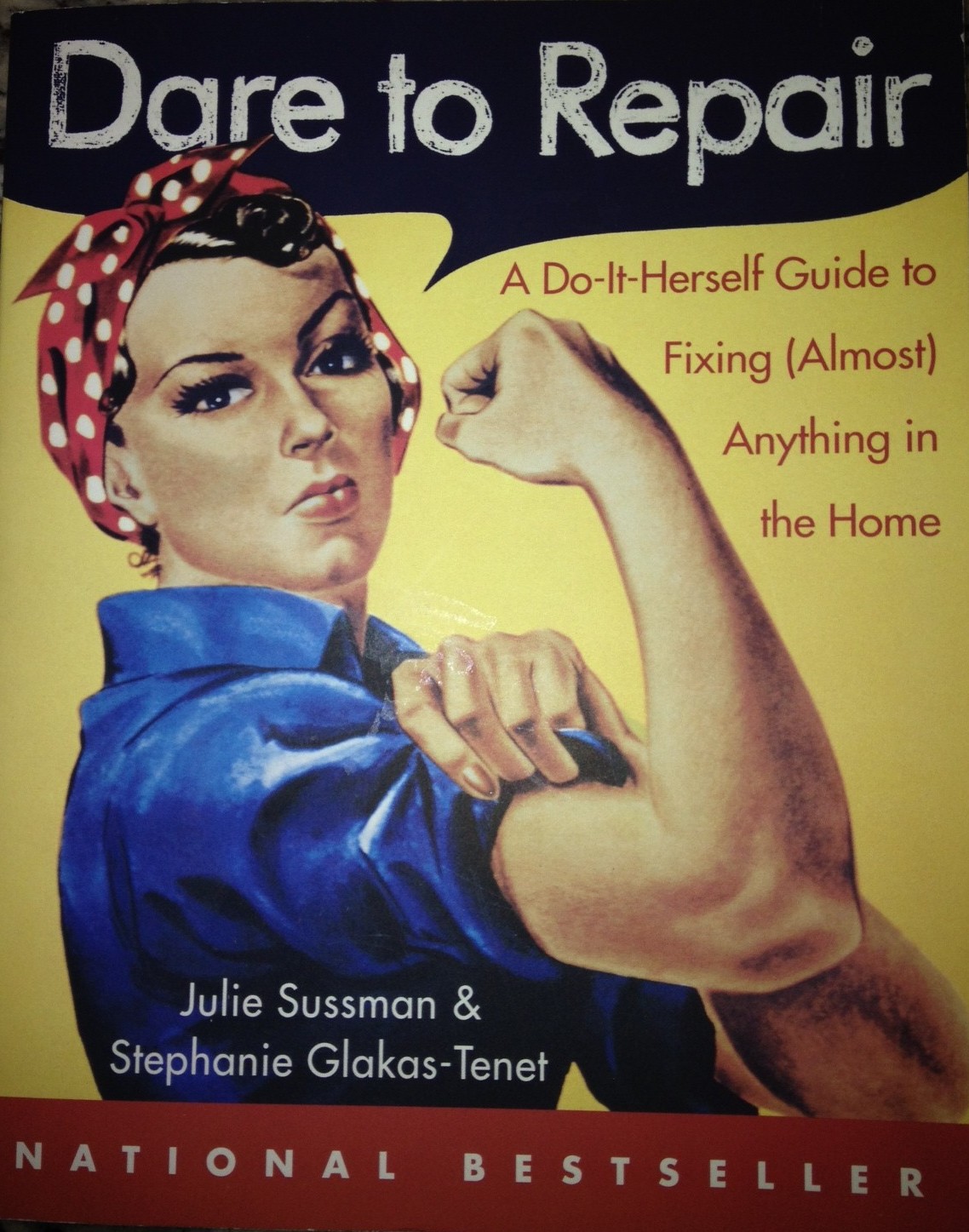
Living on my own for the last few years, I have learned to do the best I can to take care of stuff around the house with some help from books like this one: Dare to Repair

I am not the handiest person on the planet. In fact, the exact opposite is true…evidenced recently by my decision to use mounting tape to fix one of my kitchen drawers. Just so you know, I tried to use my Dare to Repair book – and some actual tools…but I resorted to mounting tape and took the easy way out. Who else besides me (and now all of you) will know what is actually holding that drawer together anyway?

My simple approach is to fix the things I can, outsource what I can afford, and ask for help when I need it. Sometimes I take shortcuts if the stakes aren’t too high. No big deal if my kitchen drawer comes apart again – but I would definitely call for help if my dishwasher caught fire (this has actually happened). If you get invited to my house for dinner, you may be asked to help me hang a picture, move some furniture or fix a drawer – but chances are you will be well fed, and I will always have some great red wine for you. And for simple situations when no help is available, I can always grab the mounting tape, duct tape…super glue…whatever works!

When it comes to taking care of me, it’s a little (make that a lot) more complicated. I had some lessons to learn and bad habits to break. Who knew that inner peace is exactly that – peace that comes from within? Sounds easy, right? Not exactly. This is not a job that we can outsource for someone else to fix. We can hire someone to help us – a coach, therapist, or enlist a life partner, mentor or friend to aid, but let me be very clear – the hard work is up each one of us as individuals.

As Emerson said so wisely in his essay Self Reliance,

“Nothing can bring you peace but yourself.”

Ralph Waldo Emerson, Self Reliance and Other Essays

Self reliance isn’t just about survival. Self reliance is depending on ourselves to be whole, happy, and authentic from within, rather than relying on others to “complete” us. This finally explains why I always hated the movie Jerry McGuire. Everyone else cried in the theatre when Tom Cruise (Jerry) tells Renee Zellweger (Dorothy): “you complete me.” I, on the other hand, kind of hated Jerry and Dorothy without really understanding why.

Working with my coach over the last few years, I came to realize that I alone am responsible for my well being, which includes my inner peace and happiness in both my personal and professional life. This did not happen overnight. And just because I am more aware doesn’t mean that I have all of the answers.  Did I just admit to the world that I don’t have the answers?? My hands are almost too clenched to even type this – that is how hard it is for me, the former Queen of Problem Solving and Always Right.

This is a continuous journey full of challenges, setbacks, highs and lows. I am practicing asking people to fix my things – but not me. Chris Martin – you can go and fix Gwyneth if you really want to, but it’s my job to fix myself.

Life Without Cruise Control

Today I decided was going to be different. Let’s back up. I had planned my eight hour drive to Wintergreen Resort in the beautiful Blue Ridge mountains of Virginia a few days ago. As I always do, I used Google Maps to plot my course before the trip, and I found two options; Option 1: The Scenic Route; Option 2: The Interstate. Both options were within 20 minutes of each other, so I immediately chose Option 2 because I knew these roads, and therefore knew what to expect. It’s all about minimizing risk,… right? Hmmm I don’t think so.

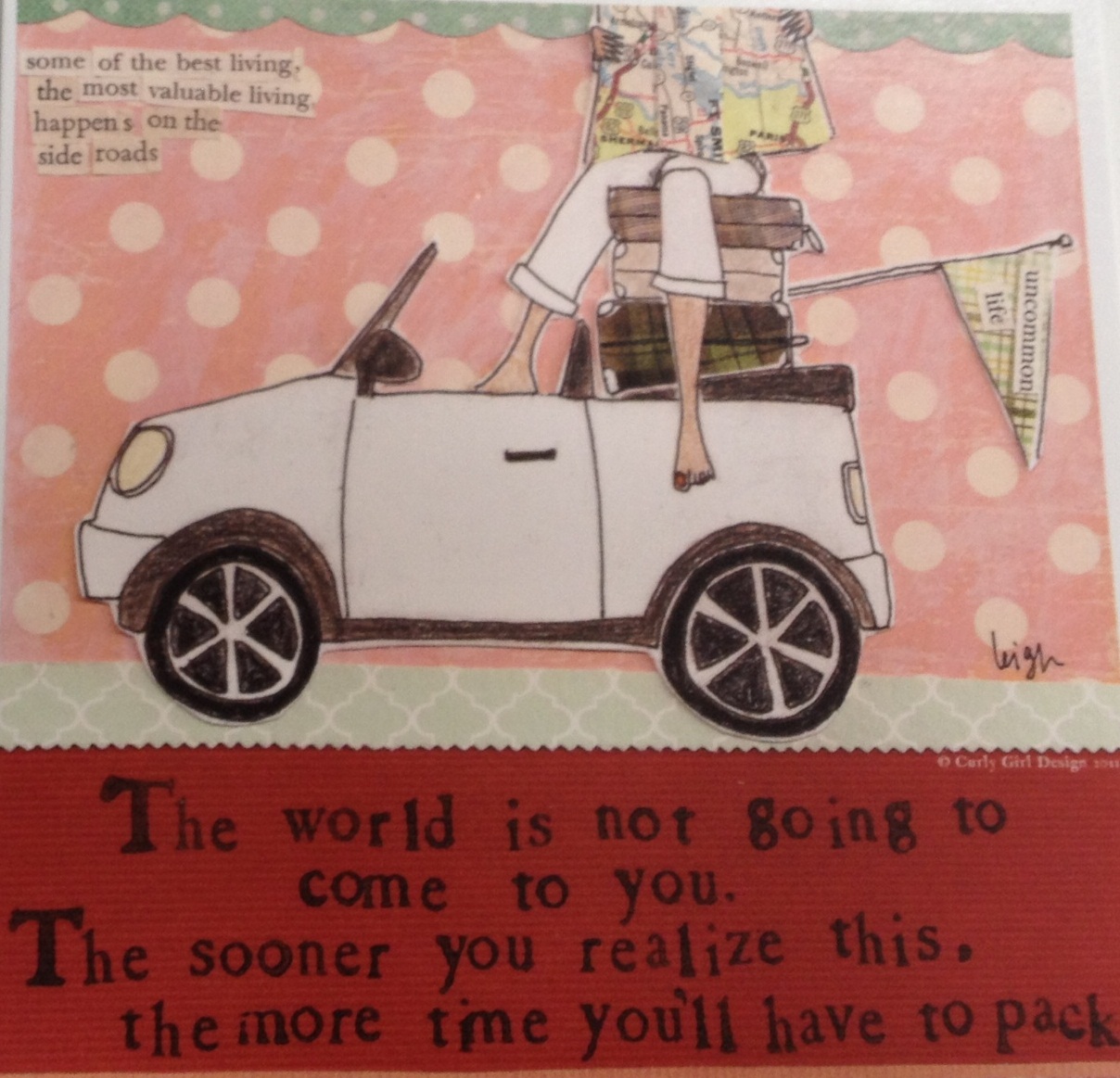
Favorite greeting card with the perfect message

Fast forward to today. I got in my car, programmed Hugh (my GPS with the Australian male voice), and sat for a few moments while he found his satellite connection. Hugh picked the Scenic Route for me…so I sat in my driveway and reconsidered my decision. The voices in my head started up: What if I break down in the middle of nowhere? What if I get a flat tire? What if I get stuck behind a slow car? What if I get lost? Could my day turn in a Stephen King novel or an episode of Vampire Diaries? Hmmmm.

Then I shifted my view of what my day could be like.

What if I see a part of SC and NC that I hadn’t seen before? How could the adventure of these twists and turns on the scenic route give me energy for the drive? What unexpected stops might I enjoy along the way? All of a sudden, I remembered one of my favorite family car trips as a child where Dad drove us along a creek just to see if he could find a place to eat lunch – and we ended up finding a little waterfall. Could my day be memorable like that day 30+ years ago?

Listening to Casey Kasem’s best hits of 1983 on the radio and feeling inspired to have a new experience, I put my trust in Hugh and off we went. The trip started great – singing along to Lionel Richie, Culture Club, Falco, and Men at Work, I was feeling both energized and peaceful. I lost Casey’s signal about 2 hours in…so I plugged in the iPod and hoped for the best as I pulled off the Interstate and onto State Road 52 in Florence. Ahhh…all was right with the world…Blue Sky set the tone for the next few hundred miles as I let my iPod shuffle my music and I explored places like Society Hill and Cheraw, SC. I can’t remember the last time I felt so relaxed behind the wheel of a car – not one orange cone or truck in sight.

As I drove, I thought about how different this drive was than it could have been. If I had taken Option 2 – I would have programmed my cruise control – and gotten annoyed every time a bad driver forced me to click the brake to release it. Maybe even more than annoyed. Probably more than annoyed. I would have been on the SAME highway I have taken probably hundreds of times…yes I would have known what to expect – really boring highway with trucks and drivers who don’t know how to use the left lane properly. I would have arrived after eight hours exhausted, hyped up on caffeine and would have had trouble falling asleep.

Instead, here I was feeling connected…peaceful, and yet full of energy. Hugh was my co-pilot keeping me from getting lost, not a gadget that I had to “beat”. I felt happy that I took the “road less travelled” and vowed to be wary of the temptations and security of cruise control in my future.

And then I started thinking about what this shift in outlook could have on my life in general.

What could my life be like if I took a different path? Yes – most of the time I have a destination (or a goal) in mind. But what new possibilities could exist for me if I chose another way to get there? Could I feel the same energy – the same peacefulness, the same connectivity between my head and my heart that I was feeling right now? What could my life be without cruise control?

What WILL my life be without cruise control?

The Rest is Still “Unwritten”

pen and paper

“I am unwritten, can’t read my mind, I’m undefined
I’m just beginning, the pen’s in my hand, ending unplanned”

-Natasha Bedingfield, “Unwritten

To me, New Year’s means new beginnings. Rather than making resolutions I won’t keep, or looking back at what mistakes I have made or what I did or didn’t accomplish in 2011, I am taking the time to reflect about what I want to do, feel and be in 2012.

What risks am I willing to take? What goals should I set across all areas of my life with my relationships with family and friends, with my career, and with my physical and spiritual self? How do I want to show up every day? How present can I be to what is in front of me each day?

There is no road map – no set course. This is both scary and exhilarating. There are a lot of choices ahead if I can take the time to stop and see them. There are both disappointments and joys ahead – if I have the courage to take some risks.

“Drench yourself in words unspoken
Live your life with arms wide open
Today is where your book begins
The rest is still unwritten”

Today I welcome 2012 with open arms. I look ahead with the hope of new possibilities, and I hope the same for you!

Happy New Year!

Wisdom From My Inner Child

What is it about this time of year that makes people go insane? I was yelled at by a scary man in a big truck in the Costco parking lot yesterday over a parking space – and rather than escalating, I maintained my “cool” in front of my niece and nephew and diffused the situation. I thought about it later – about what stress and anger do to us – and how when we assume the worst about people and their intentions – that situations can easily escalate if we walk around with such short fuses.

In keeping with my struggle to stay “present” and to remember what is was to be childlike, I have been watching a lot of my favorite childhood claymation Christmas specials. There is wisdom in remembering when things were more simple, and to apply some of these lessons to our complicated adult lives.

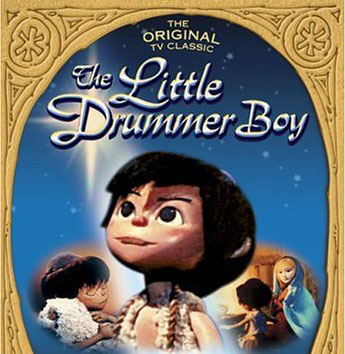
1.The Little Drummer Boy: Made in 1968, The Little Drummer Boy is old school claymation… The little boy Aaron is an orphan who hates humanity because his parents were killed by humans. His anger was a mask for the pain he felt for his loss. I happen to think that this is a universal truth among all of us: underneath deep-seated anger is pain that hasn’t healed. When Aaron sees baby Jesus, his heart becomes filled with love, which brings me to another universal truth that I believe: love heals all wounds. This quote from the movie brings tears to my eyes and sums it up better than I can:

“Aaron’s heart was filled with joy and love. And he knew at last that the hate he had carried there was wrong. As ALL hatred will ever be wrong. For more powerful, more beautiful by far than all the eons of sadness and cruelty and desolation which had come before, was that one tiny, crystalline second of laughter. Blessed are the pure in heart, for they shall see God.”

Cover of "Santa Claus Is Comin' to Town/T...

2. Santa Claus is Coming to Town: Made in 1970, this claymation movie narrated by Fred Astaire tells a story of how Santa Claus (played by Mickey Rooney) came to exist. Santa, aka Kris Kringle, wants to bring toys to children everywhere but is stopped by the evil Burgermeister Meisterburger. Kris turns to the misunderstood Winter Warlock for help by giving him a toy and melting his heart. The big lesson here is that changing is as easy as putting “one foot in front of the other”.

The Year Without a Santa Claus

3. The Year Without a Santa Claus: Made in 1974 in amazing claymation, Santa is so stressed  out that even he loses the Christmas spirit and wants to take a vacation from Christmas. Who doesn’t love the Heat Miser and Snow Miser – the uber-competitive sons of Mother Nature? Most definitely the best musical number in any Christmas special ever made! By working together, Mrs. Claus and Mother Nature get the Heat Miser and Snow Miser to compromise to let it snow in Southtown so that Santa will regain the Christmas spirit. So besides the sheer joy you will feel by simply laughing as you watch this movie, you will also learn the lesson about the value of compromise – and that we are never too old to listen to our mothers.

Presence v. Presents

Living in the moment means letting go of the past and not waiting for the future. It means living your life consciously, aware that each moment you breathe is a gift. — Oprah Winfrey


How many of you are feeling the frenzy of the holiday season like I am? Being an action oriented person, I easily fall into the perpetual trap each year of to-do lists, always adding new things, and can become “unconscious” to the rest of the world around me. How many people did I encounter today where I barely noticed what was said? Did I even look them in the eye when I was speaking to them? Or was I remembering the other 25 things I have to do today? How many times did I check my phone for email and texts while I should have been “present” with where I was at that moment? What did I miss? What did I fail to notice?

My other extreme is my “crash” at the end of the day…watching mindless TV rather than taking the time to reflect…to write…to re-energiize my body, mind and soul. With everything happening in my own life at the moment, and especially since it’s the holiday season, I find that it’s more difficult than usual to remember how powerful it can be to just be still for at least a few moments. My mind and body go back to old habits, and off I go on auto-pilot to tackle the day or prepare for the next. Does this sound familiar to you??

Here is a quick and easy technique that I learned that may help to you “wake up” during the frenzy of your day. It’s something you can do when you realize you are on auto-pilot or if you have crashed, and you want to be present to what is right in front of you – to be able to be “in the moment” with ALL of yourself. This is something you can do in as little as a minute…and/or it is something you can practice to incorporate into your way of being. Take a quick inventory of your senses:

  • What do you see? What is right in front of you, and what do you notice about it?
  • What do you hear? Really pay attention to the sounds no matter how slight.
  • What do you feel? Be mindful of the temperature, and the texture of what you are touching.
  • What do you taste?
  • What do you smell?

When you are aware of all 5 of your senses, you are truly present in the moment. If you have trouble, just watch a toddler because children are excellent at being present in the moment! The challenge now is how to stay present – or how to regain presence once it’s lost. Try this technique to help, and let me know how it works for you!

The meeting of two eternities, the past and future….is precisely the present moment. — Henry David Thoreau


Stephen Covey’s 90/10 Principle & The Power of Choice

A photo of a cup of coffee.
Image via Wikipedia

A few days ago my father sent me an email about Stephen Covey’s 90/10 Principle. My dad almost never forwards mass emails, so I knew it had to be good. The 90/10 Principle states: 10% of life is made up of what happens to you…. 90% of life is decided by how you react.

As I read it the entire article by Covey, I was struck by thinking about how powerful our choices can be, and about how often we don’t realize the power that we have in our own control.

Most of the time, we are moving so quickly that we fail to see the choices in front of us.  We have information coming at us from all directions, so we hurry to keep up so that we can get everything done. When we get “triggered”, we react – sometimes destructively – without pausing to breathe, think, or feel before taking action ourselves. I felt compelled to share Covey’s wise words as a reminder to us to WAKE UP in order to be present in these moments.

What positive outcomes might be possible if you made a different decision before reacting to your triggers?

Here is the text of Covey’s article:

Discover The 90/10 Principle.

It will change your life (at least the way you react to situations).

What is this principle?

10% of life is made up of what happens to you…. 90% of life is decided by how you react.

What does this mean? We really have no control over 10% of what happens to us.

We cannot stop the car from breaking down. The plane will be late arriving, which throws our whole schedule off. A driver may cut us off in traffic.

We have no control over this 10%. The other 90% is different. You determine the other 90%.

How? ………. By your reaction.

You cannot control a red light. but you can control your reaction. Don’t let people fool you; YOU can control how you react.

Let’s use an example.

You are eating breakfast with your family. Your daughter knocks over a cup of coffee onto your business shirt. You have no control over what just happened. What happens next will be determined by how you react.

You curse.

You harshly scold your daughter for knocking the cup over. She breaks down in tears. After scolding her, you turn to your spouse and criticize her for placing the cup too close to the edge of the table. A short verbal battle follows. You storm upstairs and change your shirt. Back downstairs, you find your daughter has been too busy crying to finish breakfast and get ready for school. She misses the bus.

Your spouse must leave immediately for work. You rush to the car and drive your daughter to school. Because you are late, you drive 40 miles an hour in a 30 mph speed limit.

After a 15-minute delay and throwing $60 traffic fine away, you arrive at school. Your daughter runs into the building without saying goodbye. After arriving at the office 20 minutes late, you find you forgot your briefcase. Your day has started terrible. As it continues, it seems to get worse and worse. You look forward to coming home.

When you arrive home, you find small wedge in your relationship with your spouse and daughter.

Why? …. Because of how you reacted in the morning.

Why did you have a bad day?

A) Did the coffee cause it?

B) Did your daughter cause it?

C) Did the policeman cause it?

D) Did you cause it?

The answer is “D”.

You had no control over what happened with the coffee. How you reacted in those 5 seconds is what caused your bad day.

Here is what could have and should have happened.

Coffee splashes over you. Your daughter is about to cry.You gently say, “Its ok honey, you just need to be more careful next time”. Grabbing a towel you rush upstairs. After grabbing a new shirt and your briefcase, you come back down in time to look through the window and see your child getting on the bus. She turns and waves. You arrive 5 minutes early and cheerfully greet the staff. Your boss comments on how good the day you are having.

Notice the difference?

Two different scenarios. Both started the same. Both ended different.

Why?

Because of how you REACTED.

You really do not have any control over 10% of what happens. The other 90% was determined by your reaction.

Here are some ways to apply the 90/10 principle. If someone says something negative about you, don’t be a sponge. Let the attack roll off like water on glass. You don’t have to let the negative comment affect you!

React properly and it will not ruin your day. A wrong reaction could result in losing a friend, being fired, getting stressed out etc.

How do you react if someone cuts you off in traffic? Do you lose your temper? Pound on the steering wheel? A friend of mine had the steering wheel fall off) Do you curse? Does your blood pressure skyrocket? Do you try and bump them?

WHO CARES if you arrive ten seconds later at work? Why let the cars ruin your drive?

Remember the 90/10 principle, and do not worry about it.

You are told you lost your job.

Why lose sleep and get irritated? It will work out. Use your worrying energy and time into finding another job.

The plane is late; it is going to mangle your schedule for the day. Why take outpour frustration on the flight attendant? She has no control over what is going on.

Use your time to study, get to know the other passenger. Why get stressed out? It will just make things worse.

Now you know the 90-10 principle. Apply it and you will be amazed at the results.

You will lose nothing if you try it. The 90-10 principle is incredible. Very few know and apply this principle.

The result?

Millions of people are suffering from undeserved stress, trials, problems and heartache. We all must understand and apply the 90/10 principle.

It CAN change your life!!!